
On a South African countertop quote, “quartz” usually means engineered stone made in a factory, while quartzite is a natural rock. “White granite” is a trade label for pale natural stones that may not be granite in the geological sense. Ask for the material type, its full name and who makes or quarries it before comparing samples or quotes.
What does “quartz” mean on a South African quote?
In a kitchen discussion, quartz usually means engineered quartz: quartz and other minerals combined with resin and pigment, then formed into slabs in a factory. The word describes a manufactured countertop material, even though quartz is also the name of a natural mineral.
Caesarstone, Silestone and Eezi Quartz are examples of engineered quartz brands. At Marble Mill, we also cut Origin Quartz, Enduro Quartz, Vicostone and Pro Quartz. A useful quote identifies both the brand and the colour, rather than saying only “white quartz”. That gives you a specific product to check against the maker’s care advice.
Manufacture gives engineered quartz a more controlled colour and pattern than quarried stone. It does not mean every slab is identical. For a veined design, check the larger pattern as well as the background colour. A small sample helps with colour choice, but it cannot show how an entire island will look.
What is quartzite?
Quartzite is a natural metamorphic rock. Geologist Hobart M. King’s description on Geology.com explains its origin: quartz-rich sandstone changes under heat, pressure and chemical activity underground. It is quarried from the earth, then cut into slabs for use as a surface.
Ask for care guidance for the particular stone you are considering.
Natural slabs vary. A quartzite sample can show the general colour and character, but the actual slab may have different bands, veins or areas of colour. If you are considering kitchen quartzite countertops, seeing the slab matters, especially for a large island where the pattern will be easy to see.
The similar names cause confusion. The surfaces company MSI notes that quartzite is sometimes called “quartz”, although the products are different. If a salesperson uses either word loosely, ask them to put “natural quartzite” or “engineered quartz” on the quote.
Are quartz and quartzite cared for in the same way?
Do not assume that shared wording means shared care. Engineered quartz has a maker and a product range whose instructions you can check. Natural quartzite needs guidance suited to the particular stone. Start with sealing and exposure to sunlight.
Caesarstone South Africa says its quartz surfaces are non-porous and do not need a sealer. For another engineered product, check that maker’s instructions. With natural stone, the Natural Stone Institute advises that some stones do not require sealing. It also explains that a sealer improves resistance to staining without making the stone stain proof.
That makes “Does this slab need sealing?” a more useful question than “How often must all quartzite be sealed?” Ask the supplier to identify the care requirements of the stone on your quote. Do not accept a fixed sealing schedule based only on the broad material name.
Standard engineered quartz is for indoors. Eezi Quartz advises protection from direct sunlight and UV exposure, including near north-facing windows. Silestone’s care guidance also advises against outdoor use or high UV exposure. Caesarstone lists a separate Outdoor Collection, so an outdoor application needs advice for the exact brand and range.
For natural quartzite near strong sun or in an outdoor area, ask the supplier to confirm suitability for that slab and use. A pale colour alone does not establish that a material belongs beside a sunny window or in a braai area.
What does “white granite” actually mean?
“White granite” does not identify one rock. It describes a pale appearance within a broad stone-trade category. Geology.com distinguishes the commercial use of “granite” from its geological definition: the trade uses the name for a wider group of hard rocks with visible, interlocking grains.
A white-grey stone with a coarse speckle may therefore be sold as granite without being a geologist’s granite. The label alone does not tell you its precise rock type, origin or care requirements. Nor does it establish that it is quartzite.
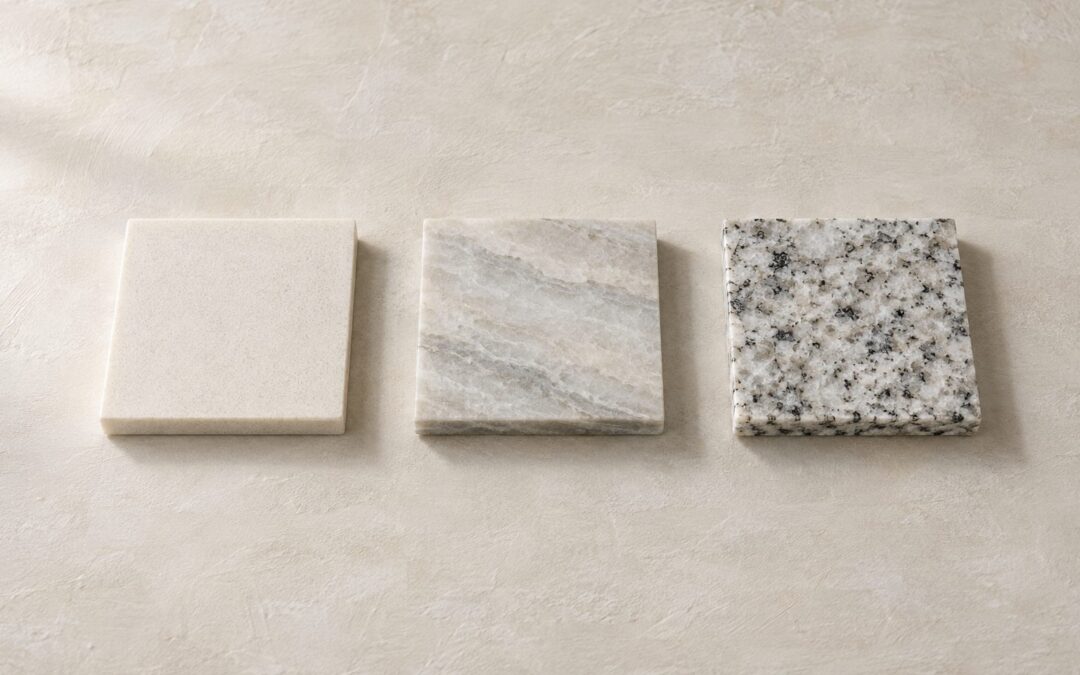
If you are comparing white granite countertops with quartzite, ask for each stone’s full trade name and its stated material type. Have the supplier record its origin where known. Then compare the actual slabs and their care advice. Three pale samples can look related while representing three different materials.
Why is Taj Mahal used for different materials?
Taj Mahal shows why a colour name cannot identify a countertop. In the natural-stone trade, Taj Mahal is a quartzite name. Origin Quartz also lists an engineered quartz colour called Taj Mahal, while Sapienstone lists a porcelain model with the same name.
Those names do not make the products interchangeable. A quote that says only “Taj Mahal” leaves the material unclear. Ask whether it means natural quartzite, Origin Quartz engineered stone or a named porcelain product. The answer determines which product information and care instructions apply.
Keep the material type, maker where applicable, and colour together when collecting quotes. If the sample says one thing and the written description says another, resolve that before ordering. A familiar name is a starting point for a conversation, not a complete specification.
What should you ask a supplier before ordering?
Take these questions to any supplier. Keep the answers with the quote so that you can check what you have chosen.
- Is this natural or engineered? Ask for the material category in writing, including whether it is quartzite, engineered quartz, granite or porcelain.
- What is its full name? Record the brand and colour for a manufactured surface. For natural stone, ask for the stone name, origin and quarry information where available.
- Does this particular stone need sealing? Ask for written care advice, including what a sealer can and cannot do.
- Can I see the actual slab or a larger sample? Check the background colour, pattern and variation. For natural stone, make the choice against the slab intended for your countertops.
- Is it suitable for this position? Explain any direct sun or outdoor exposure. Ask for confirmation for the exact product and intended use.
Which should you choose for your kitchen?
If you want a more even colour and low routine upkeep, start with engineered quartz and check the maker’s care requirements; if you want a unique natural pattern, explore natural stone and see the actual slab. For the manufactured options we cut, compare engineered stone, brand by brand.