
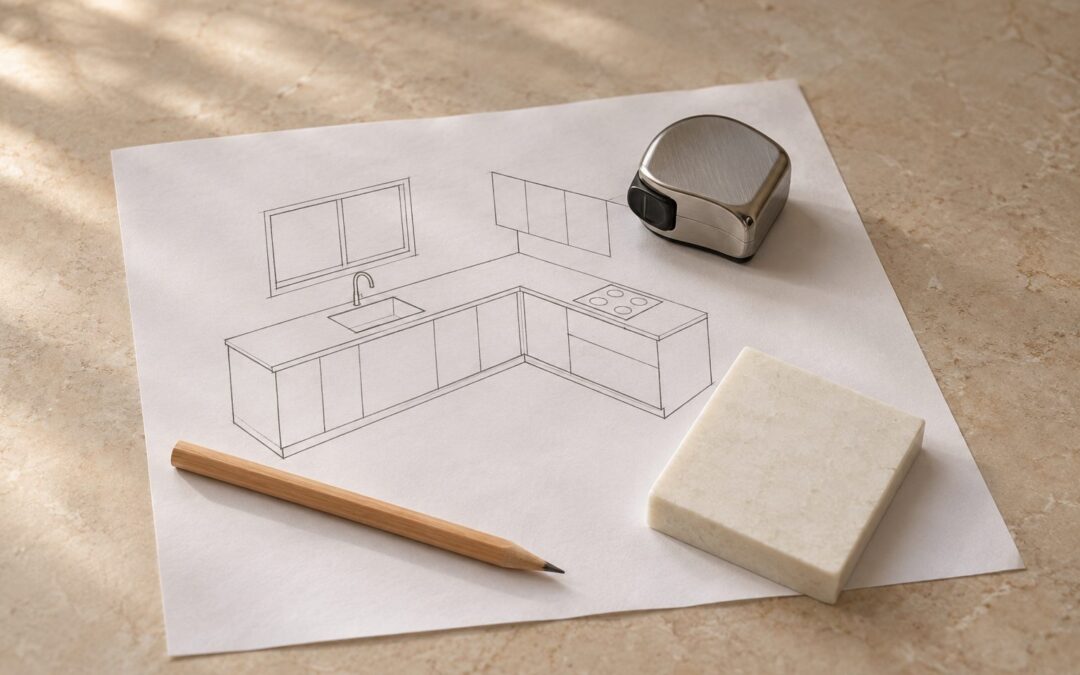
A stone countertop is priced from the slabs its layout uses and the work needed to turn them into a fitted top. Length alone cannot give you a fair price: the material, slab count, thickness, edges, cut-outs and site access all matter. A firm figure needs your measurements or a drawing, with the details of what you want included.
Why does a price per metre tell you so little?
A metre tells you length. It does not tell you depth, how many edges need polishing, or whether that stretch includes a sink. A straight counter against a wall and an island with exposed edges can have the same length but involve different pieces and work.
A price per square metre gives you area, but still leaves out how the pieces fit onto a slab. It also does not tell you what cutting, finishing or fitting is included.
Check what the advertised unit means. A figure might refer to a strip of stone, a whole slab, or a finished and fitted countertop. Those are different things to buy. Before comparing figures, ask what each one covers.
What is a stone countertop quote made of?
Think of the quote in three parts: the stone, the pieces cut from it, and the work done to those pieces. A useful breakdown starts with the chosen material and thickness, then the layout and slab count, then fabrication and installation.
The stone needs a clear description. Marble, granite, engineered quartz, porcelain and sintered surfaces are material categories, not complete product descriptions. Record the chosen stone name and finish so both quotes refer to the same selection.
Next come the pieces: counter runs, an island, a scullery top, upstands or splashbacks. Their dimensions and arrangement determine the cutting layout. Corners, curves and a pattern that needs to continue through joins can affect the work involved.
Fabrication includes cutting, shaping and polishing, with edges and openings specified. Measuring, templating and fitting also need to be accounted for. A quote may group some of this work together. What matters is that you can establish what the total includes.
Why does slab size change the price?
Stone is bought as whole slabs, then cut into the pieces the kitchen needs. Slabs come in set sizes, often a little over 3 m long, though sizes vary by brand and range. The length of your counter does not automatically match the length of an available slab.
A run only a little longer than the usable slab length can need a join or another slab. An island also needs enough slab width. Adding all the counter lengths together will not show whether the pieces can actually be cut from the selected slabs.
An L-shaped layout needs planning around its corner and joins. If the stone has a strong pattern, the direction of that pattern matters too. Keeping it flowing across adjoining pieces can change where the cuts go and how much slab is needed.
This is why a drawing helps more than a single total length. It lets the fabricator consider the whole layout. Ask what slab count the quote allows for and where joins are proposed, without assuming that every supplier handles unused stone in the same way.
What do thickness, edges and cut-outs add?
At Marble Mill, standard thicknesses are 20 mm, with 30 mm for islands and feature pieces. Agree the thickness at the start, so two quotes price the same top.
A thicker-looking edge can also be built with a mitre. An extra strip of stone is joined to the edge of a 20 mm top to create that appearance. It adds stone and hand work. Describe the edge you want, rather than relying on how thick the top looks in a photograph.
Exposed edges need finishing. An island, a curved end and a waterfall panel each bring details that a plain length measurement misses. Surface finishes such as polished, honed or leathered also belong in the specification because the finish can affect the work.
Sink and hob openings are separate pieces of work, as are tap holes and drainer grooves. The sink and hob models must be known before templating because the cut-outs follow the appliance maker’s template. Mark their positions on the drawing and supply the model details.
Upstands and splashbacks need their own dimensions. Make it clear whether you want a low strip along the wall or a taller splashback. Neither should be assumed to form part of the countertop allowance.
What does access to the kitchen change?
The finished pieces must reach the cabinets. Stairs, the distance from the unloading point and the route through the home affect carrying and how many people are needed to move the pieces safely. A large island piece needs its route considered as well as its position in the kitchen.
Describe access when asking for a quote. Mention stairs and any tight turns or narrow doorways along the route. These details help the fabricator assess the fitting work alongside the cutting work.
How do you compare two quotes fairly?
Put both quotes beside the same drawing. If a detail is missing, ask the supplier to list it before deciding what the difference in the totals means.
- Stone and finish: Are the stone name, surface finish and thickness the same?
- Layout: Are all counter runs, the island and any scullery pieces included, with slab count and proposed joins explained?
- Edges: Are the exposed edges, mitres and any waterfall panels specified?
- Openings: Is every sink, hob and tap cut-out listed, along with any drainer grooves?
- Wall pieces: Are upstands and splashbacks included at the dimensions you want?
- Fitting: Does the scope include measuring, templating and installation, with site access understood?
A missing item leaves a question to resolve. Getting it written down lets you compare the same finished kitchen across both quotes.
How do you get a firm figure?
Measuring and quotes are free at Marble Mill. You can email drawings or measurements for a quote before the cabinets are in. Include the layout, stone choice, thickness, edge details, sink and hob models, and access information.
We visit the site to measure and template once the cabinets are fixed in place. You choose the slab, and the same workshop team measures, templates, cuts and fits it.
For the next step, see how a kitchen top is quoted and send us your drawing or measurements.